How to Win at Slots — What Actually Works
Most slot strategy guides are full of myths and useless tips. This one isn't. We cover what actually changes your results when playing slots — and what's just superstition.
The Truth About Slot Outcomes
Slots use a Random Number Generator (RNG) — a chip that generates thousands of random numbers per second, even when the machine isn't being played. When you press spin, the RNG's current output determines the result. The spinning reels are purely visual entertainment; the outcome is already decided.
What this means practically: there is no "hot" or "cold" machine. A slot that hasn't paid out in an hour isn't "due" for a win. A machine that just hit a jackpot can hit another one on the very next spin. Each spin is completely independent of every other spin.
The "near miss" illusion: when you see two jackpot symbols and the third stops one position away, that feels significant — but it's not. The stops are weighted, and near-miss positions are more common than jackpot positions by design. Your brain interprets this as "almost won" but mathematically it has nothing to do with a win.
RTP — The One Number That Actually Matters
RTP (Return to Player) is the percentage of all money wagered that a slot pays back over millions of spins. A 96.5% RTP slot returns €96.50 for every €100 wagered long-term.
Practical strategy: always choose higher RTP slots. The difference between a 94% and 97% RTP slot is a 3% cost difference per spin. On 200 spins at €1 each (€200 wagered), that's €6 in expected cost difference per session. Not huge individually, but it compounds significantly over regular play.
Important: always check the RTP displayed inside the game at your specific casino. Some casinos run modified versions with lower RTPs than the developer default. The same slot can have an RTP of 96.5% at one casino and 94% at another. Open the game info (ⓘ button) and verify before playing.
Best practice: stick to Pragmatic Play, NetEnt, and Play'n GO slots — these developers use standard published RTPs and don't sell lower-RTP versions to casinos, or clearly disclose when they do.
Volatility — Matching the Game to Your Bankroll
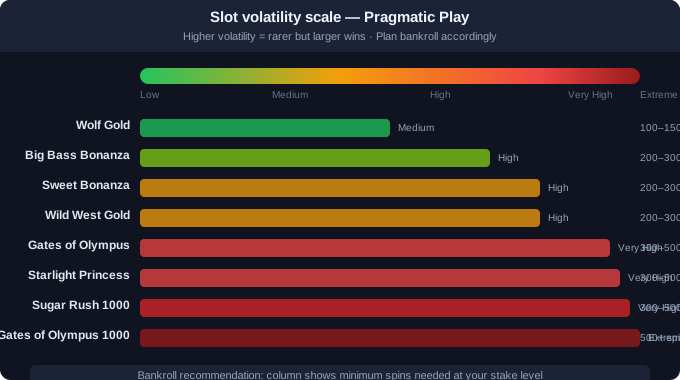
Volatility (also called variance) describes how a slot distributes its payouts. Two slots with identical RTPs can behave completely differently in a session.
Low volatility: Frequent small wins. Your bankroll depletes slowly and steadily. You're unlikely to lose your entire session budget quickly, and unlikely to win a large amount. Good for extended play on a fixed budget.
High volatility: Infrequent but larger wins. You can go 50–100 spins without a meaningful win, then hit a large payout. Requires a larger bankroll to sustain the dry spells. The upside is significantly higher maximum win potential.
Practical rule: your bankroll should be at least 100–200 spins worth for low volatility slots, and 300–500 spins for high volatility. If you only have €20 for a session, playing €1 spins on a very high volatility slot will likely end your session in 20–30 spins with nothing to show. Play lower stakes or lower volatility.
Bankroll Management — The Only Real Strategy
You cannot change the RTP or overcome the house edge in slots. What you can control is how long you play and what your loss exposure is per session. This is bankroll management, and it's the most impactful "strategy" available.
Session budget: Decide before you start how much you're willing to lose in a session. This is your entertainment budget — treat it like the cost of a cinema ticket or a meal out.
Stake sizing: Keep individual spins at 0.5–2% of your session bankroll. A €50 session bankroll at €0.50–€1 per spin gives you 50–100 spins, which is enough to experience the variance range of most slots.
Win targets and loss limits: Set a win target (e.g., "I'll cash out if I double my session budget") and stick to it. Most players who hit a big win give it back by continuing to play. If you're up significantly, withdraw the profit and continue with only your original stake.
Bonus wagering: If you're playing with a bonus, track your progress carefully. Betting above the maximum allowed stake while a bonus is active risks forfeiting the entire bonus. Check the maximum bet limit before every session.
Free Spins Features — When They Actually Pay
The feature (free spins round) is where most high-volatility slots deliver the majority of their theoretical payout. It's the variance engine. Base game spins often have low expected value; the feature is designed to be where significant wins happen.
What increases feature value: multipliers that accumulate during free spins (Gates of Olympus, Sweet Bonanza), sticky wilds that remain for the duration of the feature (Wild West Gold, The Dog House), and retriggers that extend the feature.
Buy Feature option: Many Pragmatic Play slots offer a Buy Feature button that lets you purchase the bonus round directly for a set cost (typically 50–100x the stake). The expected value is mathematically similar to triggering it through normal play. The advantage is avoiding long waits for the feature to trigger naturally. The disadvantage is cost — and in some jurisdictions, the Buy Feature is disabled.
Practical tip: demo mode is the best way to understand a slot's feature before playing for real money. Play 20–30 minutes in demo to experience what the feature feels like and how frequently it triggers.
FAQ
Can you improve your chances of winning at slots?
You can't change the RTP or overcome the mathematical house edge. What you can do: choose higher-RTP slots, play volatility levels that suit your bankroll, set and stick to session loss limits, and never bet above the maximum stake while a bonus is active.
Are slots with higher RTP worth playing?
Yes — a 97% RTP slot costs less to play per spin than a 94% RTP slot. The difference compounds over a session. Always check the in-game RTP (not just the developer's published figure) since casinos sometimes run modified lower-RTP versions.
Do slots pay more at certain times?
No — slots use RNG technology that generates random outcomes on every spin regardless of time, day, or how long since the last payout. The "hot and cold machine" concept is a myth. Each spin is completely independent.
What is the best slot strategy?
Choose high-RTP slots, match volatility to your bankroll, set a session budget before you start, size your stakes at 0.5–1% of session bankroll for high-volatility games, and cash out when you hit a target win rather than giving profits back. Rakeback systems return a percentage of your wagering regardless of results — the only genuine long-term value tool available.
Visit Casino #1 — Duel Casino
⚡ No traditional bonus — rakeback system gives you real cashback on every bet, no wagering ever.
18+ · 18+ | Please gamble responsibly | BeGambleAware.org
Key Terms Every Player Should Know
Understanding casino terminology helps you make better decisions and avoid costly misunderstandings. Here are the essential terms referenced throughout this guide and across the wider online gambling industry.
| Term | What it means | Why it matters |
|---|---|---|
| RTP | Return to Player — the percentage of wagered money a game pays back over millions of spins | Higher RTP means lower long-term cost. A 96.5% RTP loses you €3.50 per €100 wagered on average |
| House edge | The mathematical advantage the casino holds, calculated as 100% minus RTP | This is how casinos profit. A 4% house edge is standard; below 3% is excellent |
| Volatility | How a game distributes payouts — low means frequent small wins, high means rare large wins | Determines bankroll needs. High volatility requires more budget to survive dry spells |
| Wagering requirement | How many times a bonus must be bet before withdrawal is permitted | A 40x requirement on €100 means €4,000 in bets. Often makes bonuses unprofitable |
| Rakeback | A percentage of total wagering returned as real cash with no conditions | The most player-friendly reward structure — pays whether you win or lose |
| KYC | Know Your Customer — identity verification required by licensing authorities | Complete it before your first withdrawal to avoid delays of hours or days |
Common Mistakes to Avoid
Even experienced players fall into predictable traps. Avoiding these mistakes will protect your bankroll and improve your overall experience more than any single strategy tip.
- Chasing losses. The single most destructive behaviour in gambling. After a losing session, the urge to "win it back" leads to larger bets and bigger losses. Set a loss limit before you start and honour it absolutely.
- Ignoring the RTP setting. The same slot can run at 96.5% at one casino and 94% at another. Always open the in-game information panel and verify the RTP before playing — a 2.5% difference compounds enormously over time.
- Accepting every bonus. Bonuses lock your balance behind wagering requirements. If you accept a bonus and then want to withdraw, you can't until wagering is complete. For many players, declining bonuses entirely is the better choice.
- Skipping KYC until withdrawal. Completing identity verification when you want to cash out adds hours or days to your first withdrawal. Do it immediately after registration instead.
- Playing without a budget. Decide your session budget before you deposit, never during play. Money decisions made mid-session, especially after losses, are emotionally compromised.
- Misunderstanding volatility. Playing a high-volatility slot with a small bankroll guarantees you'll run out of money before the big features hit. Match your game choice to your budget.