How to Play Roulette — Odds, Bets & Best Strategy
Roulette is one of the most played casino games in the world, yet most players don't fully understand the odds behind each bet. This guide covers everything: European vs American roulette, every bet type with its exact probability, and the strategies that actually work.
European vs American vs French Roulette — The Critical Difference
The single most important decision in roulette is choosing the right wheel. The difference between European and American roulette is one number — the double zero (00) on the American wheel — but that one number nearly doubles the house edge.
European roulette has 37 numbers (0–36). House edge: 2.70%. For every €100 wagered, you lose €2.70 on average.
American roulette has 38 numbers (0–36 plus 00). House edge: 5.26%. For every €100 wagered, you lose €5.26 on average.
French roulette has 37 numbers plus two special rules: La Partage (even-money bets recover half their stake if the ball lands on 0) and En Prison (even-money bets are "imprisoned" for one more spin). These rules reduce the house edge on even-money bets to just 1.35%.
The practical advice: always play European roulette over American. And if French roulette with La Partage or En Prison is available, it offers the best odds of all three.
Every Roulette Bet Explained — Odds and Payouts
Inside bets (higher risk, higher payout):
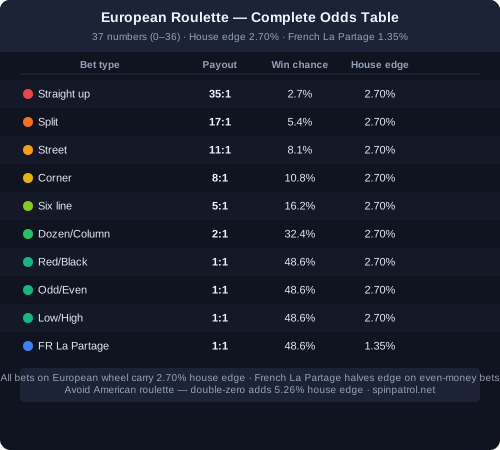
Straight up: One number. Payout 35:1. Probability 2.7% (European). This is the classic "pick your lucky number" bet. The 35:1 payout sounds impressive but reflects the low probability.
Split: Two adjacent numbers. Payout 17:1. Probability 5.4%.
Street: Three numbers in a row. Payout 11:1. Probability 8.1%.
Corner: Four numbers in a square. Payout 8:1. Probability 10.8%.
Six Line: Six numbers across two rows. Payout 5:1. Probability 16.2%.
Outside bets (lower risk, lower payout):
Red/Black: Payout 1:1. Probability 48.6% (European — 0 makes it less than 50%).
Odd/Even: Same as Red/Black.
1–18 / 19–36 (Low/High): Same as Red/Black.
Dozens: 1–12, 13–24, or 25–36. Payout 2:1. Probability 32.4%.
Columns: Payout 2:1. Probability 32.4%.
All inside bets have the same house edge as outside bets on a European wheel — 2.70%. The payout difference is just variance, not expected value.
Roulette Strategy — What Works and What Doesn't
The hard truth: no betting system changes the mathematical house edge in roulette. Every spin is independent — the wheel has no memory. The ball doesn't "know" that red has come up six times in a row.
The Martingale system (double your bet after every loss) is the most common strategy and the most misunderstood. It doesn't reduce the house edge. What it does is convert many small wins into the occasional catastrophic loss when you hit the table maximum or run out of bankroll. It's a short-term variance manager, not a winning strategy.
The Fibonacci system, the D'Alembert, the Labouchère — all variations on the same theme. They change the pattern of wins and losses but not the underlying house edge.
What actually works: play European roulette (not American), use French rules if available, stick to outside bets for extended play (lowest variance), and set strict session loss limits. The goal isn't to beat the house edge — it doesn't change. The goal is to enjoy the game with a clear-eyed understanding of your expected cost.
One genuine edge: If you find a biased wheel in a physical casino — one that lands on certain numbers more often due to mechanical wear — exploiting that can create a positive expectation. This is very rare and not applicable to online roulette where virtual RNG wheels are tested for uniform distribution.
Best Roulette Bets for Different Playing Styles
For maximum entertainment and session length: outside bets (Red/Black, Odd/Even) keep you in the game longest with the lowest per-bet variance. You'll lose gradually and steadily, but rarely experience the sharp bankroll collapses of inside betting.
For balanced excitement: dozens and columns offer 2:1 payouts with reasonable win frequency. Combining two dozen bets covers 24 of 37 numbers, creating a 64.9% win chance on each spin.
For big-win hunting: straight-up bets on individual numbers. Low probability, but 35:1 pays a meaningful sum. Some players use neighbour bets — betting on a number and the two or four numbers on either side of it on the wheel.
For pure value: French roulette with La Partage on even-money bets gives you a 1.35% house edge — one of the lowest in any casino game. In practical terms this means €1.35 expected cost per €100 wagered.
Online Roulette — Live Dealer vs RNG
Online casinos offer two types of roulette: RNG (software-generated) and live dealer.
RNG roulette uses a certified random number generator. Results are provably random and independently audited. The advantage: faster play, lower minimum bets, and you can play at your own pace.
Live dealer roulette uses real wheels spun by human dealers, streamed in real time. The wheel physics are genuine — no RNG involvement after the ball is released. The advantage: the authenticity of a real wheel, social interaction, and for those who distrust RNG software, a physical verification of fairness.
For pure odds: both are equivalent when rules are identical. For experience: live dealer is more engaging. Evolution Gaming's Lightning Roulette adds random multipliers of up to 500x to straight-up numbers, increasing variance while keeping the same baseline house edge.
FAQ
What is the best bet in roulette?
For lowest house edge: even-money bets (Red/Black, Odd/Even) on French roulette with La Partage — house edge 1.35%. For European roulette: all bets have the same 2.70% house edge, so "best" is a matter of variance preference. Avoid American roulette (5.26% house edge).
Does the Martingale system work in roulette?
The Martingale doesn't change the house edge — it converts many small wins into occasional large losses when you hit the table maximum. It can work short-term but has a mathematical expectation of loss identical to flat betting. There is no betting system that overcomes a negative expected value.
What is the difference between European and American roulette?
American roulette has an extra 00 pocket, increasing the house edge from 2.70% (European) to 5.26%. Always choose European roulette when both options are available.
What is La Partage in roulette?
La Partage is a French roulette rule where even-money bets (Red/Black, Odd/Even, High/Low) recover half their stake if the ball lands on 0. This halves the house edge on those bets to 1.35%, making it one of the best rules available to players.
Visit Casino #1 — Duel Casino
⚡ No traditional bonus — rakeback system gives you real cashback on every bet, no wagering ever.
18+ · 18+ | Please gamble responsibly | BeGambleAware.org
Key Terms Every Player Should Know
Understanding casino terminology helps you make better decisions and avoid costly misunderstandings. Here are the essential terms referenced throughout this guide and across the wider online gambling industry.
| Term | What it means | Why it matters |
|---|---|---|
| RTP | Return to Player — the percentage of wagered money a game pays back over millions of spins | Higher RTP means lower long-term cost. A 96.5% RTP loses you €3.50 per €100 wagered on average |
| House edge | The mathematical advantage the casino holds, calculated as 100% minus RTP | This is how casinos profit. A 4% house edge is standard; below 3% is excellent |
| Volatility | How a game distributes payouts — low means frequent small wins, high means rare large wins | Determines bankroll needs. High volatility requires more budget to survive dry spells |
| Wagering requirement | How many times a bonus must be bet before withdrawal is permitted | A 40x requirement on €100 means €4,000 in bets. Often makes bonuses unprofitable |
| Rakeback | A percentage of total wagering returned as real cash with no conditions | The most player-friendly reward structure — pays whether you win or lose |
| KYC | Know Your Customer — identity verification required by licensing authorities | Complete it before your first withdrawal to avoid delays of hours or days |
Common Mistakes to Avoid
Even experienced players fall into predictable traps. Avoiding these mistakes will protect your bankroll and improve your overall experience more than any single strategy tip.
- Chasing losses. The single most destructive behaviour in gambling. After a losing session, the urge to "win it back" leads to larger bets and bigger losses. Set a loss limit before you start and honour it absolutely.
- Ignoring the RTP setting. The same slot can run at 96.5% at one casino and 94% at another. Always open the in-game information panel and verify the RTP before playing — a 2.5% difference compounds enormously over time.
- Accepting every bonus. Bonuses lock your balance behind wagering requirements. If you accept a bonus and then want to withdraw, you can't until wagering is complete. For many players, declining bonuses entirely is the better choice.
- Skipping KYC until withdrawal. Completing identity verification when you want to cash out adds hours or days to your first withdrawal. Do it immediately after registration instead.
- Playing without a budget. Decide your session budget before you deposit, never during play. Money decisions made mid-session, especially after losses, are emotionally compromised.
- Misunderstanding volatility. Playing a high-volatility slot with a small bankroll guarantees you'll run out of money before the big features hit. Match your game choice to your budget.