Blackjack Basic Strategy — Complete Guide 2026
Blackjack is the only casino game where your decisions directly change the house edge. With perfect basic strategy, the house advantage drops to around 0.5% — making it the best-value game in the casino. This guide covers every decision you need to make.
What Is Basic Strategy and Why Does It Matter
Basic strategy is the mathematically optimal way to play every hand in blackjack. It tells you whether to hit, stand, double down, split, or surrender based on your two cards and the dealer's visible card. It was developed through millions of computer simulations of blackjack hands.
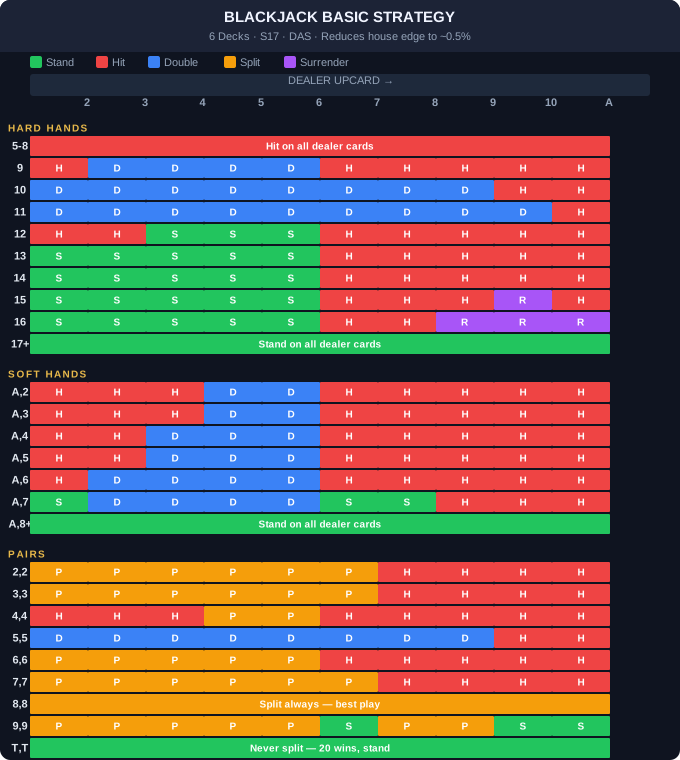
The difference basic strategy makes is dramatic. A player making random decisions faces a house edge of around 4–5%. A player using basic strategy reduces that to 0.4–0.6% depending on the specific rules of the table. That means for every €100 you bet, the expected cost drops from €4–5 to less than €1. Over a long session that difference is enormous.
Basic strategy doesn't guarantee wins — no system does. What it does is minimise your mathematical disadvantage against the house, giving you the best possible long-term results from your play.
The Core Rules — When to Hit and Stand
The fundamental decisions in blackjack: hit means you take another card, stand means you keep your current total and end your turn.
Hard hands (no Ace, or Ace counted as 1): Always stand on 17 or higher. Always hit on 8 or lower. On 9, 10 and 11 — consider doubling (see below). On 12–16, the decision depends on the dealer's card.
The critical rule most players get wrong: stand on 12–16 when the dealer shows 2–6. The dealer is likely to bust, and you should let that happen rather than risk busting yourself. Hit on 12–16 when the dealer shows 7 or higher — the dealer is unlikely to bust, so you need to improve your hand.
Soft hands (Ace counted as 11): Always stand on soft 18 or higher. Never stand on soft 17 — always hit at minimum, and double if the dealer shows 3–6. Soft 17 (Ace + 6) feels strong but the Ace gives you a free card — always use it.
Doubling Down — When to Double Your Bet
Doubling down lets you double your bet in exchange for receiving exactly one more card. Used correctly, it's one of the most powerful tools in blackjack.
Always double on 11 unless the dealer shows an Ace. The probability of drawing a 10-value card (10, J, Q, K) to make 21 is high enough to justify the extra bet in almost every situation.
Double on 10 when the dealer shows 2–9. Your expected hand strength is high and the dealer is in a moderately weak position.
Double on 9 when the dealer shows 3–6. The dealer is in the bust zone and you have a reasonable chance of hitting 19.
Soft doubling: Double Ace+6 (soft 17) and Ace+7 (soft 18) when the dealer shows 3–6. These hands benefit hugely from the dealer's bust vulnerability combined with your flexibility.
Never double on hard 12 or higher — the risk of busting with one card is too high.
Splitting Pairs — When to Split and When Not To
Always split Aces. Two Aces is a terrible starting hand (total of 2 or 12) but two starting hands of Ace each give you two strong opportunities for blackjack or high hands.
Always split 8s. A pair of 8s totals 16 — the worst hand in blackjack. Splitting gives you two hands starting from 8, which is far more manageable.
Never split 10s. Twenty is one of the strongest hands in blackjack. Splitting into two starting hands of 10 is giving up a likely winner for the chance of two mediocre hands.
Never split 5s. Two 5s is a total of 10 — an excellent hand to double on. Splitting creates two weak 5 hands.
4s, 6s, 7s, 9s: Split when the dealer shows weak cards (2–6 primarily), stand or hit when the dealer shows strong cards (7–Ace).
2s and 3s: Split when the dealer shows 2–7. The dealer's bust potential justifies the extra investment.
House Edge by Rule Variation
Not all blackjack games are equal. Rule variations significantly affect the house edge:
Blackjack pays 3:2 vs 6:5: This single rule change costs the player 1.4% in expected value. At a €25 minimum table, the difference over a session is meaningful. Always prefer 3:2 blackjack — avoid 6:5 games.
Number of decks: Single deck has the lowest house edge (around 0.1% with perfect play). Six or eight decks add approximately 0.5–0.6%. Most online blackjack uses 6 or 8 decks.
Dealer hits soft 17: Increases house edge by 0.2%. Prefer tables where dealer stands on all 17s.
Surrender option: Late surrender (allowed after dealer checks for blackjack) reduces house edge by about 0.07%. Worth using — surrender 16 against dealer 9, 10, Ace, and 15 against dealer 10.
Double after split: Reduces house edge by 0.14%. Prefer tables that allow this.
Blackjack at Online Casinos — What to Look For
Online blackjack has a significant practical advantage over live casino blackjack: you can play with a strategy chart open right next to the game. No one is watching, no one cares, and there's no social pressure to make fast decisions.
The best online blackjack games for strategy players: look for European Blackjack (no hole card, slightly different rules), Classic Blackjack with 6–8 decks and 3:2 payout, and Multihand Blackjack if you want to run multiple hands simultaneously.
Blackjack contribution to bonus wagering: most casino bonuses heavily restrict or exclude blackjack from wagering contribution — typically 5–10% contribution compared to 100% for slots. Check the bonus terms before playing blackjack with an active bonus.
The lowest house-edge option: Blackjack with perfect basic strategy sits at around 0.5% house edge, making it one of the best-value games in any casino. Combine this with a rakeback system and the expected cost per session is minimal.
FAQ
What is basic strategy in blackjack?
Basic strategy is the mathematically optimal decision (hit, stand, double, split) for every possible combination of your hand versus the dealer's upcard. Using it correctly reduces the house edge to approximately 0.5%, the lowest of any casino game.
Does basic strategy guarantee winning at blackjack?
No — basic strategy minimises the house edge but doesn't eliminate it. You'll still lose sessions. What it does is ensure you make the highest-probability decision every hand, maximising your results over the long run.
What is the house edge in blackjack with basic strategy?
With perfect basic strategy at a standard 6-deck, S17 table with 3:2 blackjack payout, the house edge is approximately 0.4–0.6%. Rule variations change this significantly — 6:5 blackjack increases the house edge by 1.4%.
Should I split 10s in blackjack?
Never split 10s. A total of 20 is one of the strongest hands in blackjack and wins the large majority of the time. Splitting converts a near-certain winner into two hands starting from 10, which is strictly worse in expected value.
Visit Casino #1 — Duel Casino
⚡ No traditional bonus — rakeback system gives you real cashback on every bet, no wagering ever.
18+ · 18+ | Please gamble responsibly | BeGambleAware.org
Key Terms Every Player Should Know
Understanding casino terminology helps you make better decisions and avoid costly misunderstandings. Here are the essential terms referenced throughout this guide and across the wider online gambling industry.
| Term | What it means | Why it matters |
|---|---|---|
| RTP | Return to Player — the percentage of wagered money a game pays back over millions of spins | Higher RTP means lower long-term cost. A 96.5% RTP loses you €3.50 per €100 wagered on average |
| House edge | The mathematical advantage the casino holds, calculated as 100% minus RTP | This is how casinos profit. A 4% house edge is standard; below 3% is excellent |
| Volatility | How a game distributes payouts — low means frequent small wins, high means rare large wins | Determines bankroll needs. High volatility requires more budget to survive dry spells |
| Wagering requirement | How many times a bonus must be bet before withdrawal is permitted | A 40x requirement on €100 means €4,000 in bets. Often makes bonuses unprofitable |
| Rakeback | A percentage of total wagering returned as real cash with no conditions | The most player-friendly reward structure — pays whether you win or lose |
| KYC | Know Your Customer — identity verification required by licensing authorities | Complete it before your first withdrawal to avoid delays of hours or days |
Common Mistakes to Avoid
Even experienced players fall into predictable traps. Avoiding these mistakes will protect your bankroll and improve your overall experience more than any single strategy tip.
- Chasing losses. The single most destructive behaviour in gambling. After a losing session, the urge to "win it back" leads to larger bets and bigger losses. Set a loss limit before you start and honour it absolutely.
- Ignoring the RTP setting. The same slot can run at 96.5% at one casino and 94% at another. Always open the in-game information panel and verify the RTP before playing — a 2.5% difference compounds enormously over time.
- Accepting every bonus. Bonuses lock your balance behind wagering requirements. If you accept a bonus and then want to withdraw, you can't until wagering is complete. For many players, declining bonuses entirely is the better choice.
- Skipping KYC until withdrawal. Completing identity verification when you want to cash out adds hours or days to your first withdrawal. Do it immediately after registration instead.
- Playing without a budget. Decide your session budget before you deposit, never during play. Money decisions made mid-session, especially after losses, are emotionally compromised.
- Misunderstanding volatility. Playing a high-volatility slot with a small bankroll guarantees you'll run out of money before the big features hit. Match your game choice to your budget.